$0 → $50M
Grown from zero as co-founder, with unit economics taken from deeply negative to profitable.
Senior ML Engineer at Runpod, London
One prompt restyles the name, the portrait and the project previews. Keys 1 to 6 work too.
I make generative models fast, cheap and reliable enough for millions of people to use every day.
Co-founder of Glam AI, which grew from $0 to $50M in annual recurring revenue and 20M+ downloads. Named inventor on three granted US patents for text-guided photo and video stylisation. Now building AI infrastructure at Runpod.
A bio for organisers and editors. Copy it as it is.
Roman Degtiarev is a machine learning engineer and founder specialising in generative AI and computer vision. He co-founded Glam AI, where he built the technology behind AI photo and video apps that reached more than 20 million downloads and grew from zero to $50 million in annual recurring revenue. He is a named inventor on granted patents in generative AI, computer vision and image and video stylisation, technology deployed in Glam AI's live products.
His work centres on a hard, practical problem: making state-of-the-art generative models fast, affordable and reliable enough for millions of everyday users. Since November 2026 he has been a Senior ML Engineer at Runpod, the AI developer cloud used by more than a million developers. Roman studied at Lomonosov Moscow State University and is based in London.
Glam AI figures as presented in my Adapty China Conf keynote, 2026.
$0 → $50M
Grown from zero as co-founder, with unit economics taken from deeply negative to profitable.
20M+
iOS and Android, frequently top 10 in the US.
4M
Using Glam AI's photo and video tools.
3 + 5
Plus five published international applications.
40+
Across backend, ML, mobile and DevOps.
From satellite images in Moscow to a keynote in Beijing.
Physics and maths at Lomonosov Moscow State University, then a master's in computer science. Mail.ru's Technosphere programme gave me my first real data pipelines, and my first applied work was detecting vehicles in satellite imagery. Images won me over because the results are visible straight away.
On PicsArt's international research team I designed a depth-estimation network with four times fewer parameters than MegaDepth at the same quality, extended it to segmentation and made a core warping algorithm 30% faster. Side quests: vector fonts generated from images and 3D photos from a single frame.
Lead developer on Neiro, an AI video platform with 60+ avatars in 140+ languages. Then I built the real-time face-and-voice technology for an experimental app that let you message friends as someone else. The founders were ready to close it; I took over marketing, analytics and experiments instead, and it went viral, reaching number one in the UAE.
An investor offered to back that product as its own company, with me as co-founder. SaidIt became Molly, and after many iterations Molly became Glam AI.
I owned the technology, backend, product roadmap, hiring, performance marketing and the P&L. We took ARR from $0 to $50M, passed 20 million downloads and 4 million monthly users, shipped product updates three to four times a week and patented the stylisation methods behind the app.
Moved to London. Gave the keynote at Adapty China Conf in Beijing, won first place at the Rork Games Hackathon and was part of an award-winning team at the London AI Hackathon.
Senior ML Engineer at Runpod, the AI developer cloud used by more than a million developers: the layer that decides how far generative AI products can scale.
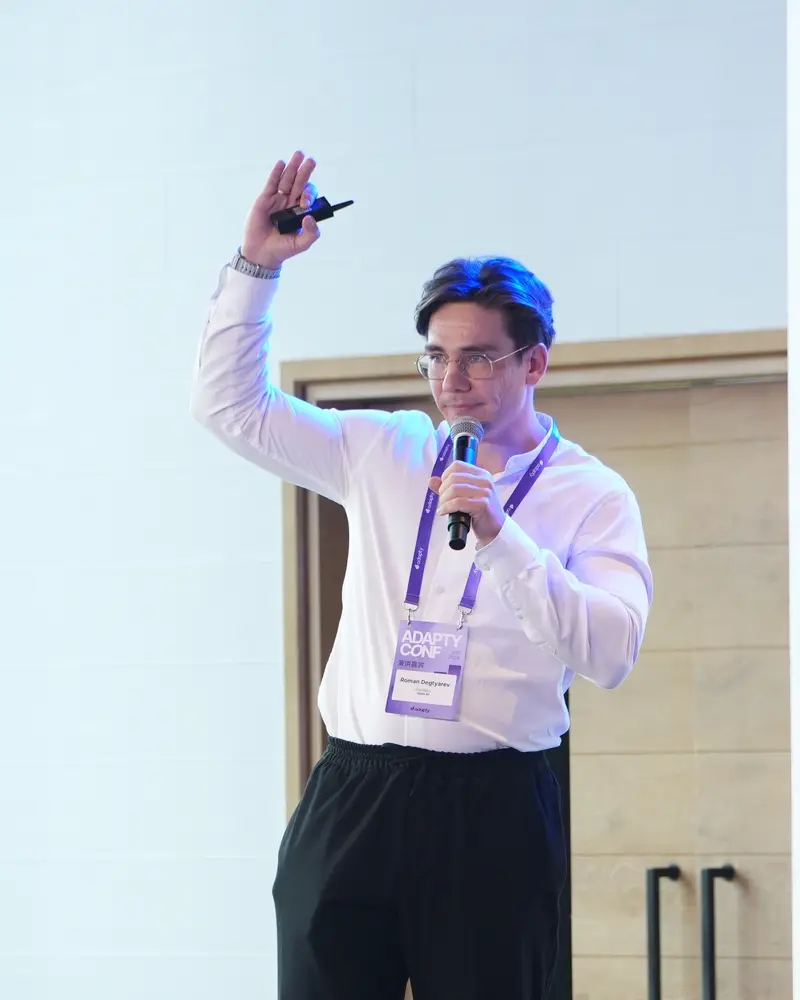
Keynote at Adapty China Conf: The Growth Route, Beijing, August 2026.

6 in 10 tests fail. That is the baseline, not a problem.
23 completed tests in three months, 9 winners, a 40% hit rate.
Conversion is diagnostics, not a criterion. Every test closes on net revenue per user or LTV, with churn, refunds and reviews as guardrails.
A mechanic that wins in one place gives zero or worse in another. Channel, placement and segment each need a retest.
Design the next iteration before the current one launches. A failed test is knowledge you paid for.
An intro offer on the yearly plan: zero purchases across 2,500 users. We checked. It was not a bug.
From letters of recommendation, quoted with permission.
“I personally have followed his expert advice repeatedly, and the results have exceeded my wildest expectations.”
“Roman is the definition of an exceptionally talented founder and engineer. … He is also a very strong expert in computer vision, one of the best I know.”
“I was eager to bring Roman on board as a cofounder because of his mad computer vision skills and his broader wisdom and experience in getting great products to customers.”
“Roman is also a master of experiments and positive unit economics.”
Hover a row for a generated preview.
AI photo and video studio: hundreds of effects, AI photoshoots and virtual try-on. 20M+ downloads, $0 to $50M ARR.
AI video with 60+ realistic avatars, custom voices and emotions, translated into 140+ languages, from script to finished video.
A party game anyone joins by scanning a QR code. During the demo the whole audience played at once. First place at the Rork Games Hackathon.
AI character chat with more than 50,000 characters, memory and voice conversations.
A depth network with four times fewer parameters than MegaDepth at equivalent performance, later adapted to segmentation.
Methods for steering image and video generation with plain language, built for and deployed in Glam AI's apps.
Restyles an input video from a text prompt: frames are warped, encoded into latent space and regenerated under the guidance of a natural-language description.
Text-guided image stylisation with latent diffusion: the photo and the prompt are encoded into a shared embedding space to generate the styled result.
Generates a new scene from three inputs: a face image, a body-pose reference and a text description of the target environment.
A pocket-sized cousin of the patents above. It runs entirely in your browser, so your photo never leaves your device.
Six awards, built under deadline.
First place
Friendsheep: the whole audience joined by QR code and played live during the demo.
Award-winning team
Built with a team that included Imperial College AI students.
Winner among 329 participants
HealthChain, a working prototype built in 36 hours at one of Europe's largest student hackathons.
Special jury award
Team OneLayerNetwork: machine learning for document search and classification inside email.
Winner
A web service that turns user photos into shareable visuals, built against the clock.
Winner
Photo and AR experiences for Snapchat's platform.
Based in London and open to events across the UK and Europe: talks, juries, guest lectures and mentoring.